English
 Español
Article Overview: This selection guide helps procurement teams, sourcing managers, and project engineers decide when an ...
Sep 05,2026


An automatic film laminating machine is a critical investment for businesses aiming to enhance product durability, aesthetics, and shelf life—especially for international markets where compliance with standards like CE, ISO, and FDA is non-negotiable. From small-batch printing shops to high-volume packaging facilities, choosing the right machine depends on your specific use case, production goals, and long-term operational costs. This guide covers everything you need to know to select an automatic film laminating machine that drives ROI and supports global growth.
The first step in choosing an automatic film laminating machine is to define your unique needs—this ensures you avoid overpaying for unnecessary features or settling for a machine that can’t keep up with demand.
Common materials include coated/uncoated paper (80–1000gsm), cardboard, corrugated board, plastic sheets (0.1–5mm), metalized film, or composite materials. For food packaging, prioritize machines compatible with FDA/REACH-compliant films.
•Low-volume (≤5,000 sheets/hour): Compact automatic film laminating machines (entry-level, cost-effective).
•Medium-volume (5,000–15,000 sheets/hour): Semi-industrial models with adjustable speed for flexible production.
•High-volume (≥15,000 sheets/hour): Heavy-duty automatic film laminating machines designed for 24/7 operation (ideal for industrial packaging).
•Pre-coated (dry) lamination: Uses pre-glued film (no on-machine glue) – perfect for small batches, quick setup, and clean operation (great for printing shops).
•Extrusion (wet) lamination: Applies molten resin (e.g., PE) for strong adhesion – ideal for heavy-duty packaging (corrugated boxes, food packaging).
•Cold vs. Hot lamination: Cold lamination for heat-sensitive substrates (photos, vinyl); hot lamination (100–160°C) for thick materials (cardboard, industrial parts).
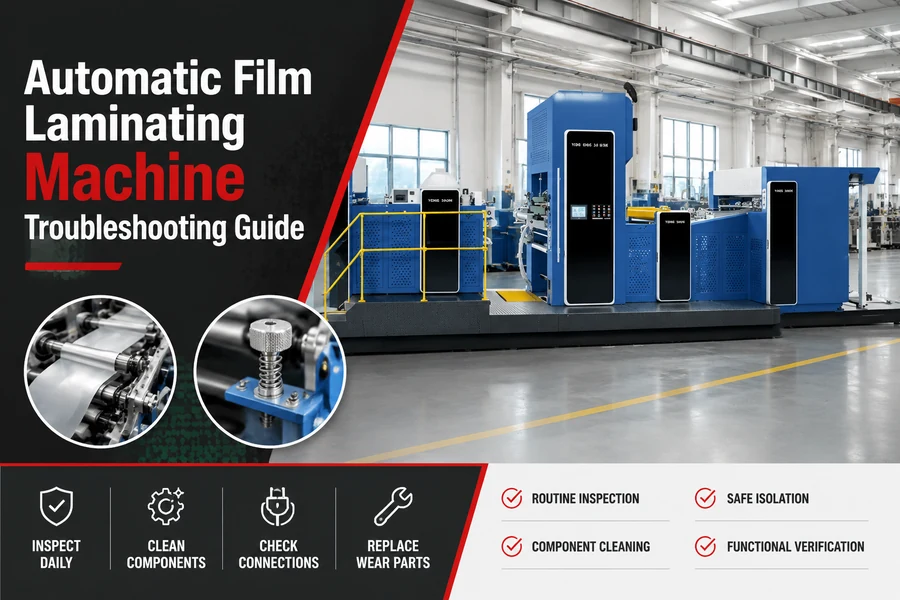
.jpg)
•Aligns with your substrate/film type and production volume
•Meets technical specs (width, speed, precision)
•Has durable components and consistent performance
•Offers user-friendly automation and low operational costs
•Comes with reliable after-sales support and certifications
•Fits your budget and TCO expectations
•Complies with international standards (CE, ISO, FDA, REACH)
Choosing the right automatic film laminating machine requires balancing your production needs, technical requirements, and global compliance goals. By focusing on substrate compatibility, speed, precision, durability, and after-sales support, you’ll select a machine that optimizes efficiency, ensures consistent quality, and supports your business’s growth in international markets.
Ready to find the perfect automatic film laminating machine for your needs? Contact YONGSHUN for personalized recommendations tailored to your industry (packaging, printing, industrial manufacturing) and production volume.
GET A QUOTE