English
 Español
Article Overview: This selection guide helps procurement teams, sourcing managers, and project engineers decide when an ...
Sep 05,2026


In the post-press packaging industry, surface finishing is no longer just “the final step.” It’s the externalization of a product’s value, the extension of a brand’s tactile identity, and a critical battlefield for a printing company’s profitability. Having been in this field for two decades, I’ve seen too many companies stuck in the outdated mindset that “a laminator just needs to stick film to paper.” They get dragged down by efficiency bottlenecks, quality complaints, and material waste—one by one.
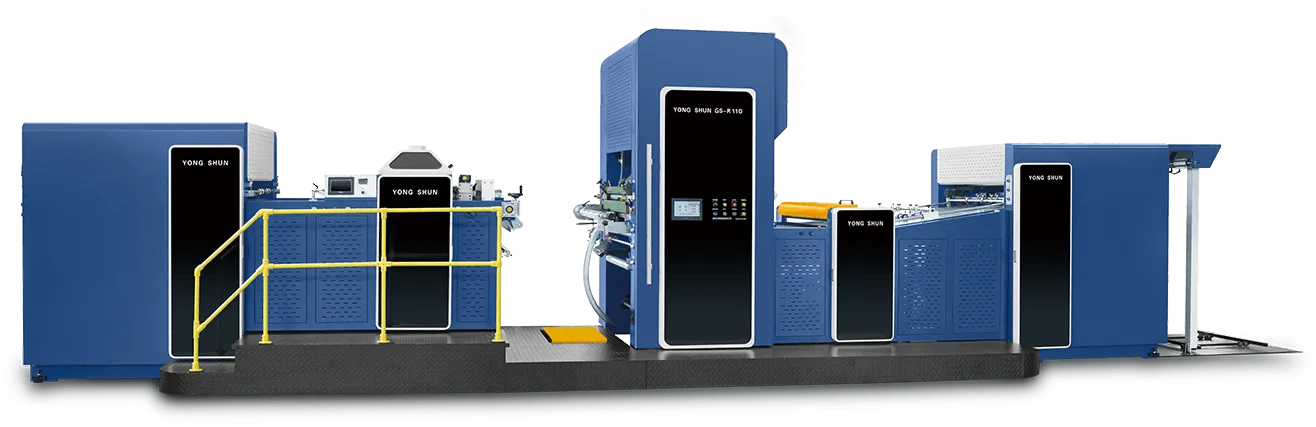
Then the GS-R110 came along. It made me realize that laminating equipment can truly evolve from a mere tool into a complete solution. This isn’t just another machine—it’s a ticket for printing houses to step into the premium packaging market.
Let’s start with a problem almost every laminating shop has encountered: leftover film edges. Traditional laminators rely on cold knives or hot‑wire cutters. If the cut isn’t clean, you need manual edge trimming—which is slow, and when you’re dealing with the narrow margins required for fine packaging boxes, the yield can drop to painfully low levels.
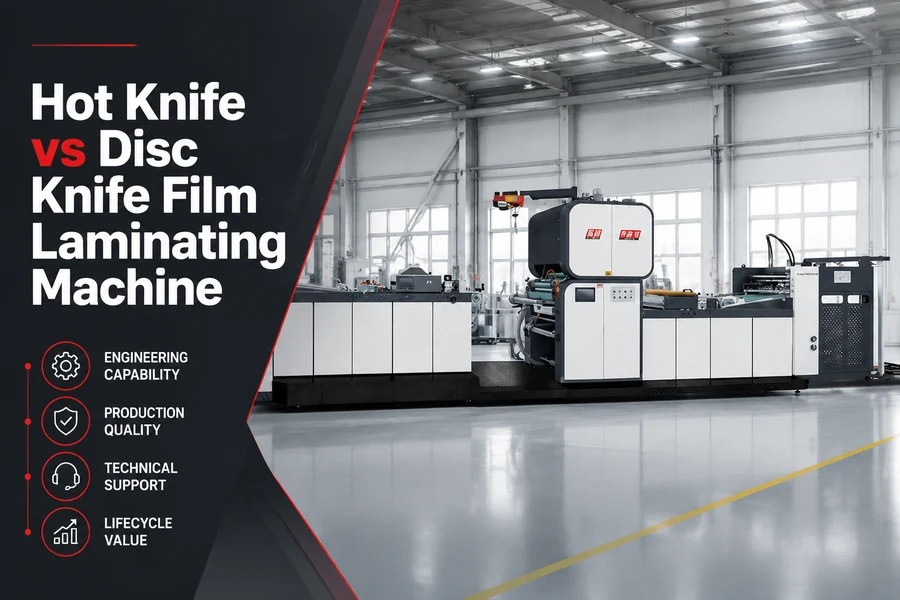
The GS-R110’s “Hot‑Knife Cutting System” solves this industry headache. In simple terms, a hot knife uses a temperature‑controlled blade to cut the film inline right after lamination. The blade stays at a stable set temperature, delivering clean, burr‑free edges without stretching or distortion. The key is that it handles margins as narrow as 5mm. What does that mean for designers and converters? It means you no longer have to compromise your designs for process limitations. It means your shop can take orders that were previously out of reach.
You might hear other brands claiming to have hot‑knife technology as well. What sets the GS-R110 system apart is the combination of intelligent temperature control and servo‑driven precision. Temperature fluctuations are held within ±2°C, and the cutting carriage follows the web with an accuracy of 0.1mm. In plain language, whether you’re running a batch of 30,000 sheets or a short run of a few hundred for sampling, the result remains consistently clean.
Another feature worth diving into is the tension control system.
Many older laminators handle paper below 80gsm by what feels like guesswork. Too much tension and the paper wrinkles; too little and you get air bubbles. Operators spend more time tweaking knobs than actually running production.
The GS-R110 uses a closed‑loop tension control system with two independently driven roller sections. If that sounds technical, here’s the plain‑English version: it acts like a skilled driver who constantly senses the road conditions and adjusts the throttle in real time. The machine’s sensors check the paper state hundreds of times per second and automatically coordinate the speed difference between the front and rear rollers. This keeps the substrate under constant, ideal tension from the moment it enters until it leaves.
I tested it with 90gsm lightweight paper—a notoriously tricky material—running 5,000 consecutive sheets. The film surface stayed perfectly flat, and register accuracy was spot‑on across the entire run. That’s something traditional machines would struggle to achieve.
Now, let’s talk about a point that’s often overlooked but makes a massive difference in daily use: the all‑servo drive architecture.
The GS-R110 uses independent servo motors for all key stations—feeding, laminating, cutting, and stacking. This isn’t the old “one motor drives one long shaft” setup. Instead, every station has its own “brain” and “muscle.” The payoff is immediate: job changeover time drops from 15 minutes to under three minutes. All parameters are stored digitally. The next time you run the same job, just load the recipe and the machine positions itself automatically—no senior operator needed to crank handwheels.
The control panel is a 15‑inch touchscreen with an intuitive interface. In our shop, a new trainee was independently operating it after just two days of training. In an industry where skilled labor is hard to find and labor costs keep rising, that benefit can’t be overstated.
The GS-R110 is positioned as a flagship model, but its versatility surprised me.
In premium gift box production, it’s used for BOPP gloss lamination. With the hot‑knife system I mentioned, box edges stay bubble‑free and don’t lift. The boxes run smoothly through automatic folder‑gluers with a yield rate above 98%. For high‑end photo books and book covers, the laminating surface is exceptionally flat and the film adhesion is strong—critical for subsequent processes like digital foiling or UV coating, where delamination can ruin a job.
Digital printing is another sweet spot. Small batches, high variety, fast turnaround—those are the hallmarks of digital work. The GS-R110’s quick changeover and recipe‑based presets fit this perfectly. Whether you’re running B2 digital proofs or SRA3 short‑run orders, the machine delivers consistent, stable results.
To be honest, evaluating a laminator can’t stop at a spec sheet. You have to look at its stability during continuous production, its tolerance for different materials, and whether your operators actually want to use it.
What gives me confidence in the GS-R110 is this: it takes complex technical challenges—hot‑knife temperature control, tension regulation, servo synchronization—and encapsulates them into an automated system that makes operation simple and results reliable. It doesn’t feel like a cold piece of iron; it feels like a dependable partner in the process.
If you’re considering upgrading your laminating equipment, here’s my advice: don’t just look at how fast it can run. Look at how well it handles the jobs that used to be a headache. In that regard, the GS-R110 truly earns its flagship name.
GET A QUOTE