English
 Español
Struggling with bubbles, wrinkles or peeling on your laminated sheets? This guide explains how to tune temperature, roll...
Nov 12,2026


A laminating machine can have the most advanced servo drives and cutting systems, but if the temperature is too low, the pressure is uneven, or the wrong film is loaded, the final output will still bubble, peel, or curl. Operators often find themselves adjusting settings by trial and error, wasting expensive substrates. This guide breaks down the three foundational variables of paper lamination—heat, pressure, and film—translating machine parameters into practical results so you can dial in your process with confidence. For a broader contextual understanding of how this fits into the entire production line, you can refer to the comprehensive guide on understanding the complete industrial film lamination process.
Successful lamination relies on a delicate balance of three core elements. Adjusting one without considering the others often leads to new defects.
Temperature: Activates the adhesive (in pre-coated films) or evaporates the water content (in water-based glues). Too low, and the film won't stick; too high, and the paper may curl or the film may shrink.
Pressure: Forces trapped air out and pushes the adhesive into the microscopic pores of the paper. Uneven pressure across the roller width causes bubbles and wrinkles.
Film Selection: Determines the required temperature, the tactile finish, and the downstream processing compatibility (like die-cutting or folding).
Modern machines are designed to make controlling these variables intuitive. When you are evaluating machinery that supports these precise variable settings, look for features like intelligent PLC temperature control and independent hydraulic pressure systems.
Temperature is the most common source of lamination defects. The goal is to reach the activation threshold of your specific adhesive without over-stressing the paper fibers.
For Thermal Pre-coated Films: Most standard pre-coated films (like BOPP or PET) require surface temperatures between 90°C and 110°C at the lamination nip. If the temperature is too low, the adhesive won't melt completely, resulting in poor peel strength and silvering (a hazy, cloudy look).
For Water-based Glue Systems: The temperature is required at the drying tunnel, not the main lamination roller. The goal is to evaporate the water content from the glue entirely as the paper passes through. If moisture remains trapped, it will cause the paper to wrinkle or expand later.
The Paper Curl Factor: Thin paper (under 120gsm) is highly sensitive to heat. Excessive heat draws moisture out of the paper fibers, causing the sheet to curl immediately upon cooling. Machines equipped with electromagnetic heating combined with oil heating maintain a more stable, evenly distributed temperature (±1°C) compared to older coil heaters, reducing thermal shock to thin papers.
Pressure without heat is ineffective, and heat without pressure cannot bond the film. The lamination nip—the point where the steel heating roller meets the rubber pressure roller—is where the magic happens.
Uniformity is More Important than Raw Force: A common misconception is that "more pressure is better." In reality, 0.5 MPa of evenly distributed pressure is superior to 2 MPa applied unevenly. Uneven pressure leads to trapped air pockets (bubbles) on one side of the sheet while the other side bonds perfectly.
The Role of the Rubber Roller: The rubber roller must have perfect cylindrical symmetry. Over time, wear or paper dust can cause slight depressions on the rubber surface. Operators should routinely check the "nip line" (the contact point between the hot steel roller and the rubber roller) by using a feeler gauge or nip impression paper to ensure it is perfectly parallel across the width.
Servo Pressure in Action: Advanced machines use hydraulic or pneumatic systems to apply pressure dynamically. If you run 200gsm paper on Monday and 350gsm cardstock on Tuesday, the pressure must be increased for the thicker board to force the film into the deeper surface valleys.
The film is not just a clear layer; its chemical composition dictates how it behaves under heat and how it interacts with downstream processes like die-cutting.
| Film Type | Typical Thickness | Best Applied To | Machine Temperature Need | Downstream Consideration |
|---|---|---|---|---|
| BOPP | 15-27 microns | Commercial offset print, magazines, catalogs | Medium | Excellent for folding; minimal cracking at creases. |
| PET | 12-25 microns | Luxury packaging, cosmetic boxes, covers | High | Very rigid; requires a hot knife or precise slit to avoid cracking edges during die-cutting. |
| OPP | 18-28 microns | General packaging, flyers | Medium | Can become brittle; requires good tension control to avoid snapping. |
| Matte / Soft-touch | 20-35 microns | High-end brochures, business cards, luxury packaging | Medium-High | The textured surface makes visual inspection of bubbles difficult; requires high roller pressure. |
| Metalized | 15-25 microns | Cosmetic boxes, retail packaging | High | The metallic layer is fragile; excessive pressure or uneven heat can cause silver streaking or cracking. |
If you need to switch between film types or paper weights frequently, choosing a versatile machine is key. Reviewing the different configurations available for high-speed and multi-purpose laminating can help you determine if your current equipment has the flexibility required for your film and substrate mix.
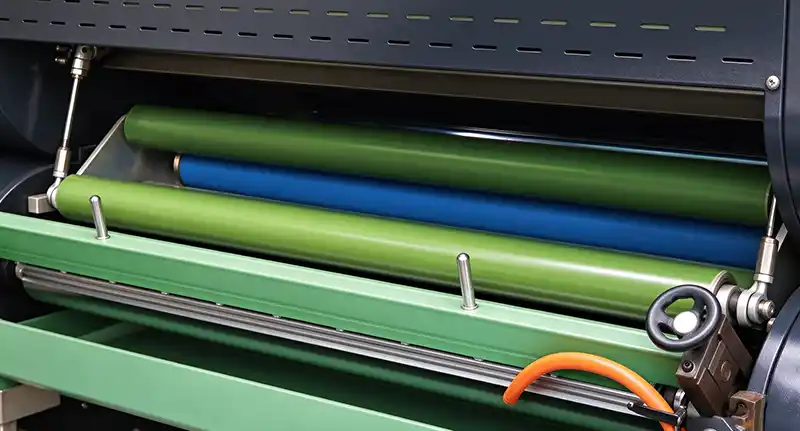
When starting a new job or troubleshooting a specific defect, follow this systematic setup routine to dial in the three pillars.
Run a Sample Sheet (The "Destructive" Test):
Why: Datasheets provide a starting point, but every batch of paper and film behaves differently based on ambient temperature and humidity.
How: Run one sheet at normal speed. Once it cools, try to peel the film edge. If it peels easily, your temperature or pressure is too low.
Adjust Temperature First, Speed Second:
Why: If the bond is weak, increasing temperature directly addresses the adhesive activation. Increasing dwell time (by slowing down the machine) also works, but reduces your throughput.
How: Increase the heating roller temperature by 5°C increments. If the paper starts to curl or the film shrinks (wavy edges), drop the temperature and slow down the machine speed instead.
Tune Roller Pressure for Bubbles:
Why: If the bond is strong but bubbles are present, the pressure roller is not squeezing out the air evenly.
How: Slightly increase the pressure and check the nip uniformity. If bubbles persist only on one side, the pressure roller is likely not parallel and needs mechanical adjustment.
Evaluate the Downstream Process:
Why: A perfectly laminated sheet is useless if it cracks when folded or jams in the die-cutter.
How: Take the test sheet and run it through a creasing machine or die-cutter. If the film cracks at the fold, you may need a softer film (like BOPP instead of PET) or a hot-knife cutting system to ensure edges are sealed.
The Challenge: Printers running large volumes of 100gsm or 128gsm posters and brochures constantly battle paper curl. The heat of the lamination process dries the paper, causing it to roll up as it cools on the delivery stack.
The Solution: In this scenario, temperature control and anti-curl mechanisms are the critical variables. Machines with a dedicated anti-curl device apply slight reverse tension to the sheet. Furthermore, running the water-based glue method instead of thermal pre-coated film allows the drying process to pull moisture evenly, reducing the curl effect. Exploring specific packaging and commercial printing solutions can reveal how these machines integrate with existing offset press lines.
The Challenge: Cosmetic boxes and rigid gift boxes use thick board (300gsm+) and PET film for a mirror-like finish. The main issue here is edge peeling and micro-bubbles after die-cutting.
The Solution: Here, pressure and cutting system are the dominant factors. The machine must deliver high pressure to embed the PET film into the rough cardstock. Crucially, standard disc knives will leave a tail that causes delamination during box gluing. A hot knife system is required to melt and seal the PET edge perfectly. You can see how this configuration is engineered by reviewing the mechanics of hot knife laminating machines.

Mastering the interplay of temperature, pressure, and film selection transforms lamination from a guessing game into a predictable manufacturing process. However, operator skill alone cannot compensate for a machine that lacks precise thermal control, rigid roller construction, or adequate heating capacity.
Once you have clarified the ideal parameters for your specific paper and film mix, comparing the technical specifications of available equipment becomes the next logical step. Yongshun’s technical team, backed by over 27 years of manufacturing experience and a complete CE-certified quality assurance system, provides comprehensive installation, training, and technical support to ensure your operators can confidently dial in these settings.
This article is part of YONGSHUN’s technical content library. No direct sales or pricing information is included. All technical discussions aim to help you make informed purchasing decisions.
GET A QUOTE