English
 Español
Hot knife, disc knife or chain knife? This guide compares edge quality, film compatibility and throughput so you can mat...
Oct 19,2026


When a laminating machine jams at the cutting station or leaves a tail of film hanging from a PET-laminated carton, the root cause is often not the film itself—it is the cutting system. Buyers comparing automatic film laminating machines quickly discover that “hot knife,” “disc knife,” and “chain knife” are not interchangeable terms. Each cutting method produces a different edge, runs at a different speed, and behaves differently across OPP, PET, PVC, and metallized films. Understanding how these cutting systems differ is a core part of the broader selection framework for automatic film laminating machines, and this guide breaks down the technical trade-offs so you can eliminate the wrong system before requesting a quotation.
In an automatic film laminating machine, the cutting unit sits between lamination and stacking. Its job is to separate the continuous film between sheets cleanly, without tearing the paper or leaving a tail that interferes with downstream die-cutting, gluing, or folding. If your lamination line feeds into specific downstream processes like die-cutting, folding, or window patching, it is worth reviewing how these systems integrate into different industrial laminating applications before making a final machine decision.
A poor cut does more than look untidy. It can cause sheets to stick together during stacking, create film debris that contaminates the lamination roller, and force operators to slow the machine below its rated speed to compensate. For packaging converters running 10,000 sheets per day, a cutting system mismatch turns a 100 m/min machine into a 60 m/min machine in practice.
The global automatic film laminating machine market was valued at US323millionin2025andisprojectedtoreachUS323millionin2025andisprojectedtoreachUS 464 million by 2032, growing at a CAGR of 5.4%. This growth is accompanied by increasing film variety—soft-touch, metallized, and thin-gauge PET films—which makes the cutting decision more consequential than it was a decade ago, when OPP and BOPP dominated.
A hot knife uses a heated blade, often reaching temperatures that require controlled heating treatment, to melt the film as it cuts. The melted edge seals immediately, producing what the industry calls a “tail-free” cut. On the automatic film laminating machine with hot knife, the knife is paired with electromagnetic and oil heating systems, and the cutting unit is designed for OPP, PET, and PVC films with servo-controlled positioning.
The practical benefit is edge quality. A sealed edge prevents film from peeling back during gluing or folding, which matters most on thick cardstock, PET film, and luxury packaging where the cut edge is visible or stress-bearing. The trade-off is speed: hot knife cutting typically runs below the maximum mechanical speed of the machine. In one reference configuration, a machine rated at 105 m/min had a hot knife working speed of 70–80 m/min.

A disc knife uses a rotating circular blade to score and separate the film. It does not rely on heat to seal the edge; it relies on mechanical sharpness and blade geometry. On the high-speed disc knife laminating platform, the disc knife system is associated with fast separation and low paper waste, which is why they are common on commercial printing machines handling catalogs, flyers, and business cards.
The trade-off is edge condition. A disc knife can leave a small tail or raw edge on certain films, particularly PET and metallized film, because the film is cut rather than sealed. For commercial print where the edge is trimmed off in a later folding or die-cutting step, this is acceptable. For packaging where the laminated edge becomes part of the finished product, it may not be.
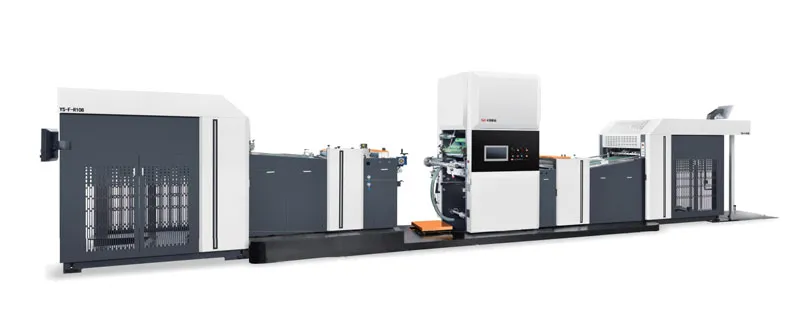
A chain knife uses a chain-driven blade mechanism. Its distinguishing characteristic is multi-purpose capability: chain knife systems are frequently specified on the multi-purpose chain knife configuration, which needs to run water-based glue, pre-coated film, and non-adhesive film on the same platform.
Chain knife cutting is not a “best of both worlds” solution—it has its own limitations. Industry technical descriptions note that chain knife cutting can produce tail film and broken film, with the effect becoming more significant on thick paper, potentially affecting the next process. The value of the chain knife is flexibility across film types and substrates, not superior edge sealing.

| Criterion | Hot Knife | Disc Knife | Chain Knife |
|---|---|---|---|
| Edge formation | Melted and sealed | Mechanically cut | Mechanically cut by chain blade |
| Typical edge outcome | Tail-free, sealed | Clean cut, may leave small tail | Can leave tail film, more noticeable on thick paper |
| Working speed tendency | Below platform maximum | Fastest of the three | Moderate to high, varies by film |
| Strongest film match | PET, metallized, BOPP, PVC | OPP, BOPP, standard commercial films | Multi-purpose: water-based, pre-coated, non-adhesive |
| Best substrate fit | Thick cardstock, luxury packaging | Thin to medium commercial paper | Mixed orders, flexible production |
| Maintenance focus | Knife temperature control, blade condition | Blade sharpness, alignment | Chain tension, blade condition |
| Downstream impact | Sealed edge supports gluing and folding | Small tail may require trimming | Tail film can interfere with stacking or die-cutting |
The speed difference is worth translating into daily output. If a hot knife configuration runs at 70–80 m/min on a given substrate while a disc knife configuration on the same class of machine runs at 80–100 m/min, the effective throughput difference over an eight-hour shift can be several thousand sheets, depending on sheet size and operator efficiency. That does not make one system “better”; it means the cutting system must be matched to whether edge sealing or raw throughput is the binding constraint.
If your output is cosmetic boxes, perfume boxes, or electronics packaging where the laminated edge is visible and must accept glue without peeling, hot knife is the default choice. The sealed edge eliminates the tail that would otherwise need to be trimmed or hidden inside a fold. A machine with hot pressing after the hot knife cut adds a further step: the pressing unit removes micro-bubbles and improves surface gloss, which is relevant when the package surface is the brand’s primary visual asset. You can review how a hot pressing configuration changes surface quality on Yongshun’s product page without committing to a specific model.
For catalogs, flyers, brochures, and business cards, speed and waste minimization usually outweigh edge sealing. The disc knife’s faster separation and lower paper waste align with the economics of commercial print, where sheets are typically trimmed or folded after lamination.
Factories that cannot dedicate a machine to a single film type—shops running water-based glue for food packaging one day and pre-coated film for commercial work the next—often land on a chain knife multi-purpose machine. The chain knife does not deliver the sealed edge of a hot knife or the raw speed of a disc knife, but it avoids the capital cost and floor-space requirement of two separate machines.
The cutting system is one variable among several that determine whether a machine performs in production. Use the following checklist to keep the comparison grounded in verifiable specifications rather than brochure claims.
1. Request the working speed for your specific film, not the mechanical speed.
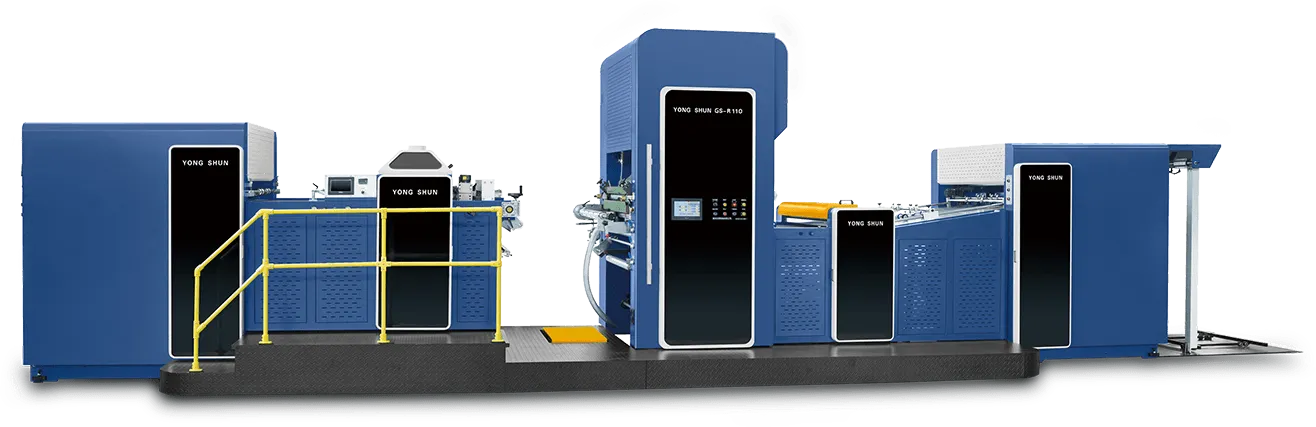
A machine rated at 120 m/min mechanical speed may run substantially slower with a hot knife on thick PET. Ask for the recommended operating speed for your exact film and paper weight combination. Yongshun’s GS-R110 platform, for example, lists a mechanical speed range of 20–120 m/min but offers chain, disc, and hot knife cutter configurations on the same base platform—confirm which cutter is being quoted and what the working speed is for your job.
2. Confirm CE conformity and the applicable safety standards.
For EU-bound equipment, CE marking should reference the Machinery Directive 2006/42/EC and the risk assessment standard EN ISO 12100:2010, among others. A declaration that lists only “CE certified” without naming the directives and harmonized standards is incomplete. Yongshun maintains a quality assurance system and certification documentation covering CE requirements.
3. Verify the cutting unit’s film compatibility against your actual film.
“Compatible with OPP, PET, PVC” is a starting point, not a specification. Ask whether the hot knife unit is rated for metallized film, whether the disc knife is specified for thin-gauge PET, and whether the chain knife’s tail-film behavior has been tested on your paper weight.
4. Account for energy consumption at the cutting and heating stage.
ISO 14955-5:2020 specifies technical requirements for evaluating energy supplied during the use phase of machine tools, and explicitly includes foiling and laminating machines within its scope. Energy efficiency is not only an operating-cost question; it affects heat stability. A heating system that cannot hold temperature during high-speed cutting will produce inconsistent hot knife sealing.
5. Check changeover time between cutting configurations if flexibility matters.
Some platforms allow cutter type to be specified at order but not easily changed in the field. If your production mix may shift from commercial print to packaging within the machine’s service life, clarify whether the cutting unit can be reconfigured and at what cost.
Once the cutting system direction is clear—hot knife for sealed edges, disc knife for commercial throughput, or chain knife for multi-film flexibility—the remaining variables are paper size range, film thickness compatibility, automation level, and after-sales support. Yongshun has been manufacturing laminating machines since 1997, with 27+ years of experience, a 12,000 m² factory, and a dedicated R&D team. The company’s manufacturing and service background covers installation and commissioning, spare parts replacement, and online technical consulting.
This article is part of YONGSHUN’s technical content library. No direct sales or pricing information is included. All technical discussions aim to help you make informed purchasing decisions.
GET A QUOTE